

Choosing the Right Line Shaft Bearing: Why Material Matters More Than You Think
Most bearing failures don’t happen because the bearing was “bad.”
They happen because the material didn’t match the real-world conditions, like dirty water, misalignment, heat, load, or all of the above.
Line shaft bearings live in tough environments. And while bronze has long been the default, it’s not always the safest or longest-lasting choice anymore.
This guide breaks down the most common line shaft bearing materials and shows where each one performs best (and where it breaks down).
Understanding The 4 Most Common Line Shaft Bearing Materials
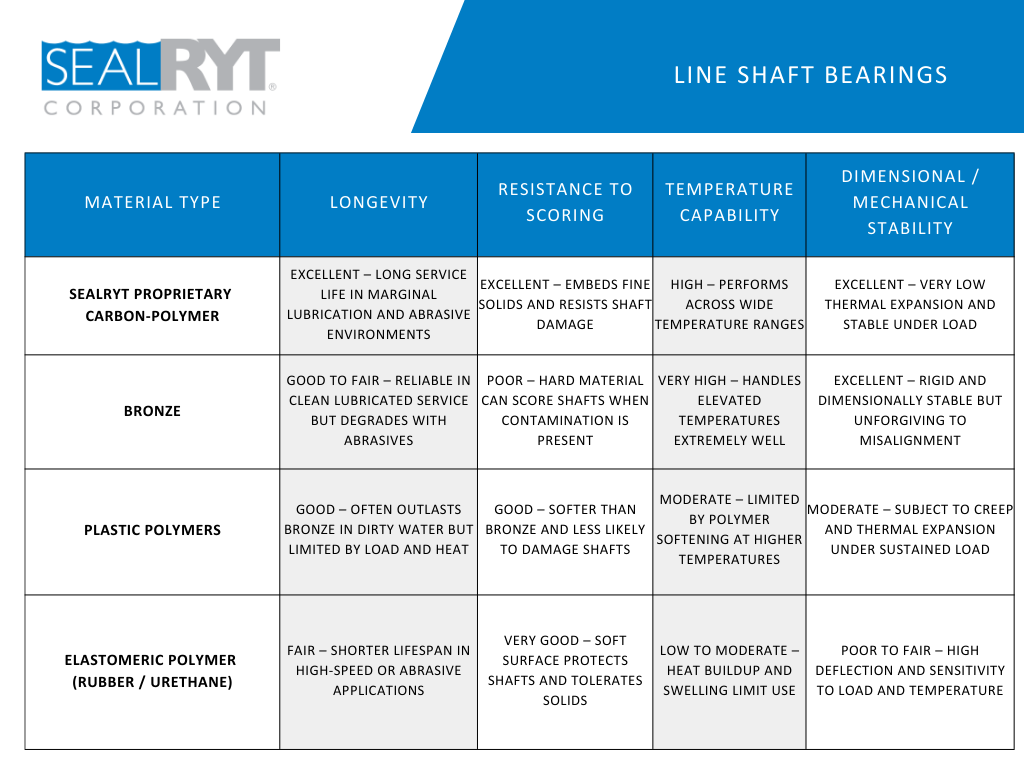
1. Carbon-Polymer (SealRyt proprietary blend)
Carbon-polymer bearings perform exceptionally well in:
● Marginal lubrication
● Abrasive or dirty water
● Systems with minor misalignment or vibration
Key advantages:
● Long service life even when lubrication isn’t perfect
● Excellent resistance to scoring by embedding fine solids
● Very low thermal expansion and strong dimensional stability
This balance of toughness and forgiveness is why carbon-polymer is often the safest choice for industrial and slurry applications. (Learn more about our Carbon-Polymer Line Shaft Bearings here)
2. Bronze
Bronze has earned its reputation as the traditional go-to material. It works best when:
● The fluid is clean
● Alignment is precise
● Lubrication is consistent
Key advantages:
● Excellent dimensional stability
● Handles very high temperatures
Limitations/Tradeoff:
● The mix of hard material and contamination can lead to shaft scoring
● Performance drops quickly in abrasive environments
● Bronze shines in controlled systems, but it’s far less forgiving when conditions drift.
3. Plastic Polymers
Plastic polymers sit in the middle of the pack. They’re often used in:
● Water-lubricated systems
● Cost-sensitive installs
Key advantages:
● Softer than bronze, reducing shaft damage risk
● Can outlast bronze in dirty water at lower loads
Limitations/Tradeoff:
● Moderate temperature tolerance
● Susceptible to creep and thermal expansion under sustained load
They’re a solid compromise, but not ideal for higher-load or hotter applications.
4. Elastomeric Polymers (Rubber / Urethane)
These materials prioritize shaft protection above all else. They’re best suited for:
● Low-speed applications
● Shock loads
● Systems where shaft damage is the primary concern
Limitations/Tradeoff:
● Shorter lifespan in abrasive or high-speed service
● High deflection and sensitivity to heat and load
Elastomeric Polymers protect well, but sacrifice stability and longevity.
How Do I Choose The Best LineShaft Bearing Material?
The “best” line shaft bearing isn’t universal, it’s application-specific.
If your system doesn’t live in a perfect lab environment, material choice becomes even more critical. Choosing the right bearing up front can mean fewer shutdowns, less shaft damage, and longer service intervals.
If you don’t want to overthink it, here’s the quick guide:
● Dirty water, slurry, industrial service - Carbon-polymer
● Clean water, high temperature, rigid systems - Bronze
● Moderate water service, budget-driven installs - Plastic polymer
● Low speed, shock load, shaft protection priority - Elastomeric polymer
Or, contact our team - we’re happy to help.
If you want to learn more about pump seals, mechanical packing, failure points, or any rotating shaft sealing questions then contact one of our engineers. We have been sealing shafts for over 20 years in all types of industries.
